
SPOILERS AHEAD (obviously)…
A film written and directed by Frank E. Abney III, running just eight minutes, Canvas is a touching animated short film that explores the weight of grief and overcoming obstacles to find joy even in those dark moments. In this heartfelt story, a man suffering from the loss of his wife struggles to find the means and inspiration to resume his passion for painting. Beyond the man’s connection to visual art, the story is relatable to a broad audience on many levels, as grief is a universal experience, a part of what makes this piece powerful.
Canvas is a short film with no dialogue, depending on its detailed visuals and soft musical background to tell its story. While the film covers dark and painful feelings, it is wholesome at its core and offers heartwarming feelings or family, love, and inspiration. Representations of grieving feelings, overcoming hard times with support from family, dreams, and the symbolism surrounding visual art are all elements that add depth to this encouraging story.
The Weight of Grief
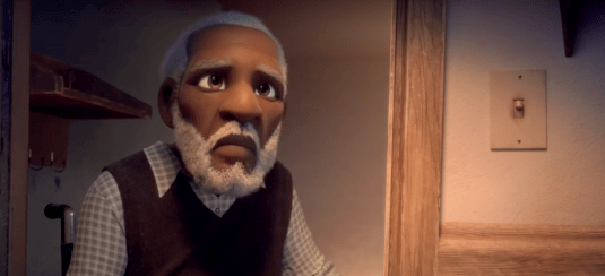
Heavy moments showcasing the protagonist’s grief play a large role in Canvas. When he first wakes up from his dream where he paints his late wife, he is shown laying in bed with the other side vacant. He appears disturbed, upset to be alone. As he begins to move through the house, the audience can see that the walls are barren, and the home is basically vacant aside from a few basic household items and a nook containing the wife’s old possessions. This is a symbolic moment. The man’s life is empty without his love, and the house is a visual representation of this feeling.
The man’s daughter arrives at his home with his granddaughter, who presents him with a drawing she made as a gift. He treasures it and gives her a warm hug. However, later on, when the granddaughter gestures for him to draw with her, he declines. The man allows himself to accept the joy of his granddaughter’s youthful love for art, but when he is offered the chance to enjoy the art himself, it crosses a line. He refuses to let himself soothe his pain with his passion. This is an authentic side effect of grief, being unable to enjoy things that were once great sources of pleasure. These heavy moments make the ultimate conflict of the story very clear.
A Gentle Push

The man’s granddaughter shares his love of visual art. It is made clear that she loves to draw and yearns for her grandfather to join her. As she sits down to draw once again at his house, she drops a crayon and it rolls out of sight. While searching for it, she accidentally stumbles upon the nook housing all of her grandmother’s old possessions. Beyond this, she finds that behind a covered door is her grandfather’s old art studio, containing an unfinished painting of his. When he first discovers her in the studio, looking at the painting, he seems angered. This feeling quickly dissipates, though, when he ponders the painting himself. He struggles to accept it, but his granddaughter brings him to touch the canvas, lighting up his world once again.
This painting pulls the man into a dream-like atmosphere where he and his wife are reunited in the afterlife. This moment gives him the permission he needed to pick up a paintbrush again and rediscover his love of art. The end of the film sees the man, with support from his daughter and granddaughter, doing what he loves most and touching a paintbrush to the canvas once again. This moment may resonate with a broad audience, as it represents courage and support of loved ones to overcome the devastating effects of grief and rediscover passion and joy.
Sweet Dreams

Dreams play a large role in Canvas, as they act as catalysts for later events in the story. The film opens on a dreamscape where the protagonist paints on a canvas while his wife sits in the foreground, sipping coffee. Later, when the protagonist is awake, he ventures out to his yard, revealing a similar scene to the dreamscape, except his wife is not there and the easel is empty. This evokes a moment of frustration, a strong contrast to the warm feelings the protagonist experienced in his dream. Additionally, the colors of this scene are muted, again, contrasting the brightness of the dreamscape and symbolizing how the world feels dim as the protagonist grieves.
Later, when the protagonist’s granddaughter stumbles upon his unfinished painting, it strongly resembles the scene from the dreamscape at the beginning of the film, tying the character back to happy memories. When the granddaughter brings him to touch the canvas, his world his lit up and he is pulled back into another dreamscape, where he and his wife are reunited in the afterlife. This joyful moment is what gives him the permission and encouragement he has needed to enjoy art once again.
Seeing is Believing
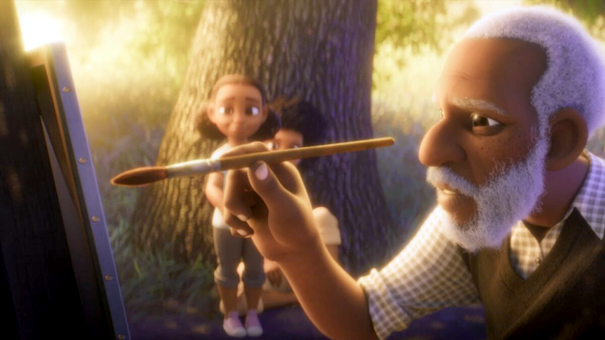
Visual art is obviously a prominent theme in this short film, but there are elements that are not so obvious, adding more layers to this motif. Canvas contains no dialogue, making its only soundscape soft music playing in the background. This makes the film dominantly visual, a piece of visual art, which is fitting considering visual art’s role in the story. This theme also subtly plays into the dreamscapes of the film. While the moments of reality are reminiscent of the CGI and animation style Pixar uses for its films, the dreamscapes appear in the style of moving sketches. They look like drawings, adding another component of visual art into the movement of the storyline. Canvas is a visual representation of a man overcoming his grief with support of his family, using visual art as a prominent theme to strengthen its significance.